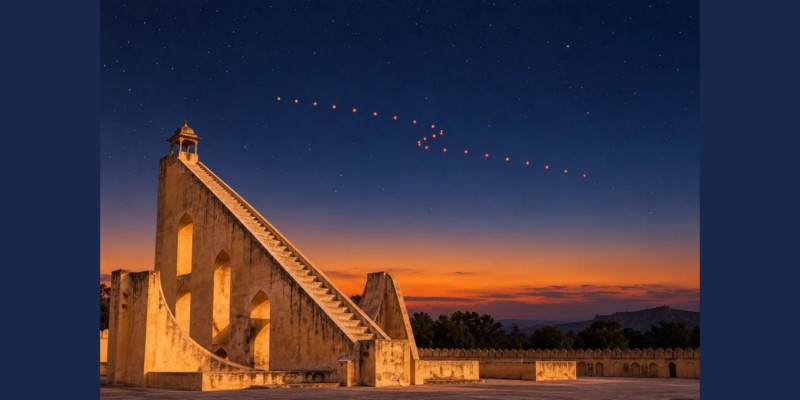
In Jyotish, a retrograde planet, called vakri, is one that appears to move backwards through the zodiac when seen from Earth. Classical texts do not treat this as a weakness. A retrograde planet gains cheshta bala, the strength that comes from motion and effort, so its results become more intense and more inward, and they often arrive with delay or on a second attempt. Whether that intensity helps or hurts depends on the houses the planet rules, the house it occupies, and the planets that influence it.
Why a Planet Seems to Move Backwards
No planet actually reverses its orbit. Retrograde motion is an optical effect of watching the sky from a moving Earth, and astronomers have long explained the apparent retrograde motion of planets through the difference in orbital speeds. Anyone who has travelled by train has seen the same thing. When an express overtakes a slower train on the next track, the slower train seems to slide backwards for a while, although both are moving forward. Mars, Jupiter and Saturn appear retrograde when Earth overtakes them, roughly when they stand opposite the Sun, while Mercury and Venus appear retrograde as they pass between Earth and the Sun.
The Sanskrit word vakri means curved or crooked, which describes the loop a planet traces against the stars. The Sun and Moon never go retrograde. Rahu and Ketu, the lunar nodes, move backwards through the signs as a rule, so for them backward motion is the normal state and not a special condition. That leaves five grahas whose retrogression needs interpretation: Mercury, Venus, Mars, Jupiter and Saturn.
Cheshta Bala and the Strength of Effort
Brihat Parashara Hora Shastra measures planetary strength through shadbala, six separate sources of strength. One of them is directional strength, or dig bala, which depends on the house a planet occupies. Another is cheshta bala, motional strength, and the text gives retrograde motion the highest cheshta bala score among all the types of planetary motion. Mantreswara's Phaladeepika goes further and says that a retrograde planet possesses strength even when it sits in its sign of debilitation or in an enemy's sign.
The word cheshta means effort, and effort is the easiest way for a beginner to understand a retrograde planet. Walking forward along a familiar lane needs little attention, while walking backwards along the same lane demands concentration with every step. A retrograde planet works in a similar way. It pursues the matters of its houses with unusual persistence, and people with such placements often keep returning to the same goal until it is settled.
Strong Does Not Always Mean Favourable
The classics agree that retrogression adds strength, but they differ on whether that strength is helpful. Kalyana Varma's Saravali holds that a retrograde benefic becomes very powerful and can give rajayoga, while a retrograde malefic brings sorrow and aimless wandering. Kalidasa's Uttara Kalamrita equates retrogression with exaltation, yet adds that a planet retrograde in its own sign of exaltation behaves like a debilitated one. Both texts treat retrogression as something that magnifies whatever a planet already promises in the chart.
In practice, the planet's lordship comes first. In a hypothetical chart where the sixth lord is retrograde, the person may show great stamina in competitive exams, litigation, or service roles, because the planet is pressing hard on sixth-house matters. A benefic aspect on a retrograde planet usually steadies its results. Such a planet also tends to become central during its own Mahadasha or Antardasha, so knowing the Vimshottari dasha periods helps in judging when its effects will peak.
What Each Retrograde Planet Means
Retrograde Mercury
Mercury (Budha) goes retrograde about three times a year for roughly three weeks, which makes its retrogression the most frequent. Since Mercury governs the analytical mind, retrogression turns thinking inward. People with retrograde Mercury tend to revisit ideas, question what others accept, and absorb knowledge through reflection rather than rote learning. They may understand more than they can easily put into words, and some become overly critical or quick to justify their own choices. Retrograde dates are astronomical events, so a general Mercury retrograde calendar gives timings that apply in Jyotish too, although the sidereal sign may differ from the one listed.
Retrograde Venus
Once every nineteen months or so, Venus (Shukra) turns retrograde for around six weeks. As the significator of love, marriage, comfort, and art, retrograde Venus often raises expectations in relationships to a subtle and demanding level. Affection may be deeply felt but expressed with hesitation, and old relationships or unfinished emotional matters can return for review. The same inward pull can also produce refined artistic taste. The seventh house, the strength of its lord and any benefic aspects decide whether this becomes discernment or dissatisfaction.
Retrograde Mars
Mars (Mangal) turns retrograde about once every twenty-six months, for roughly two to two and a half months. Its energy, normally direct and outward, becomes stored. A person with retrograde Mars may stay calm for long stretches and then react sharply when pushed past a limit. Determination is strong, sometimes stubborn, and some authors associate the dasha of a retrograde Mars with disputes or litigation. The same planet can give extraordinary endurance when it rules favourable houses, and its energy has a clear target.
Retrograde Jupiter
Jupiter (Brihaspati), the planet of wisdom, faith, teachers and children, stays retrograde for about four months in roughly every thirteen. People with this placement tend to examine inherited beliefs instead of accepting them, preferring understanding earned through their own reflection, and they are often more practical about whom they trust. Some authors note delays in Jupiter's significations, such as children or long journeys, but the fifth and ninth houses must confirm this before it is read into a chart.
Retrograde Saturn
Saturn (Shani) already signifies hard work and discipline, and it stays retrograde for around four and a half months each year. Retrogression intensifies both qualities. People with retrograde Saturn often carry heavy responsibility, prefer working alone, and can sustain pressure for long periods. Self-doubt or friction with authority may accompany this, and Saturn's familiar pattern of delay can show up as a task that succeeds only on the second attempt. Work left unfinished in the past frequently gets completed under its influence.
Checking Retrograde Planets in a Chart
Most birth charts mark a retrograde planet with an (R) or the word vakri beside its degree. For the present sky, this page about current positions of planets on Moon Dasha shows the sign and degree each graha occupies right now and indicates which planets are currently retrograde. This makes it easy to compare the current sky with a birth chart, since some astrologers observe that a natal retrograde planet revives its themes whenever it turns retrograde again in transit. Some also read a retrograde planet's influence on the house just behind it, though this rule remains debated. Astrologers also make a related distinction: a planet that turns retrograde and then direct within one sign is called vakri, while one that slips back into the previous sign is called ativakri, and its influence on that earlier sign is easier to argue for.
Conclusion
A retrograde planet adds intensity, persistence, and an inward quality to whatever it already represents in a chart. Because it already carries extra strength, many astrologers avoid gemstones meant to strengthen it and prefer charity, prayer, or disciplined effort related to the planet. A sound reading weighs retrogression together with lordship, house placement, aspects, dignity, and dasha, since those factors show where the planet's extra effort will go.